
Imagine someone asking ChatGPT or Perplexity to recommend a product in your category. You want your product to be mentioned, described accurately, and considered in that answer. That is the kind of AI visibility I'm talking about here.
You'll see this work described as AEO (answer engine optimization) or GEO (generative engine optimization). The practical aim is to help people discover your product through an AI-generated answer.
That is what makes Peec AI interesting to me. Its recommendations come with evidence: content that keeps getting cited, catalogs that keep appearing in answers, and a reason to consider doing something about it. Connect it to Claude through MCP, and you can work through those recommendations with an assistant that helps turn them into concrete changes.
If you build or market a product and already use Claude, this combination is worth a look.
I'm working on GoodSender, a platform that brings your company blog, newsletter, and transactional email into one place. You can publish on your own domain, reach subscribers by email, and manage your blog through Claude or another AI assistant using MCP.
My goal is for GoodSender to appear when people ask AI tools for relevant product recommendations. Peec AI supplies the evidence and recommendations; Claude helps me put them to work.
recommendations with receipts
What I like is that Peec gives me a reason to consider the work. A directory recommendation is useful when I can see why that directory matters. A content recommendation is useful when there is evidence for that kind of content.
Paraphrasing the kinds of recommendations I mean:
- A particular kind of content is cited repeatedly. It is worth creating something similar for the relevant topic.
- A particular catalog appears repeatedly in citations. It is worth listing the product there, with guidance on the keywords to use.
The citation pattern gives the task a basis. It explains why this content or this catalog deserves attention.
That is much more useful to me than a bare instruction to register somewhere or publish another listicle. I want enough context to judge the recommendation and then do the work properly.
Peec's Actions documentation describes the supporting evidence behind recommendations, including the sources and competitors contributing to a visibility gap. Claude brings that evidence into the conversation where I work through the task.
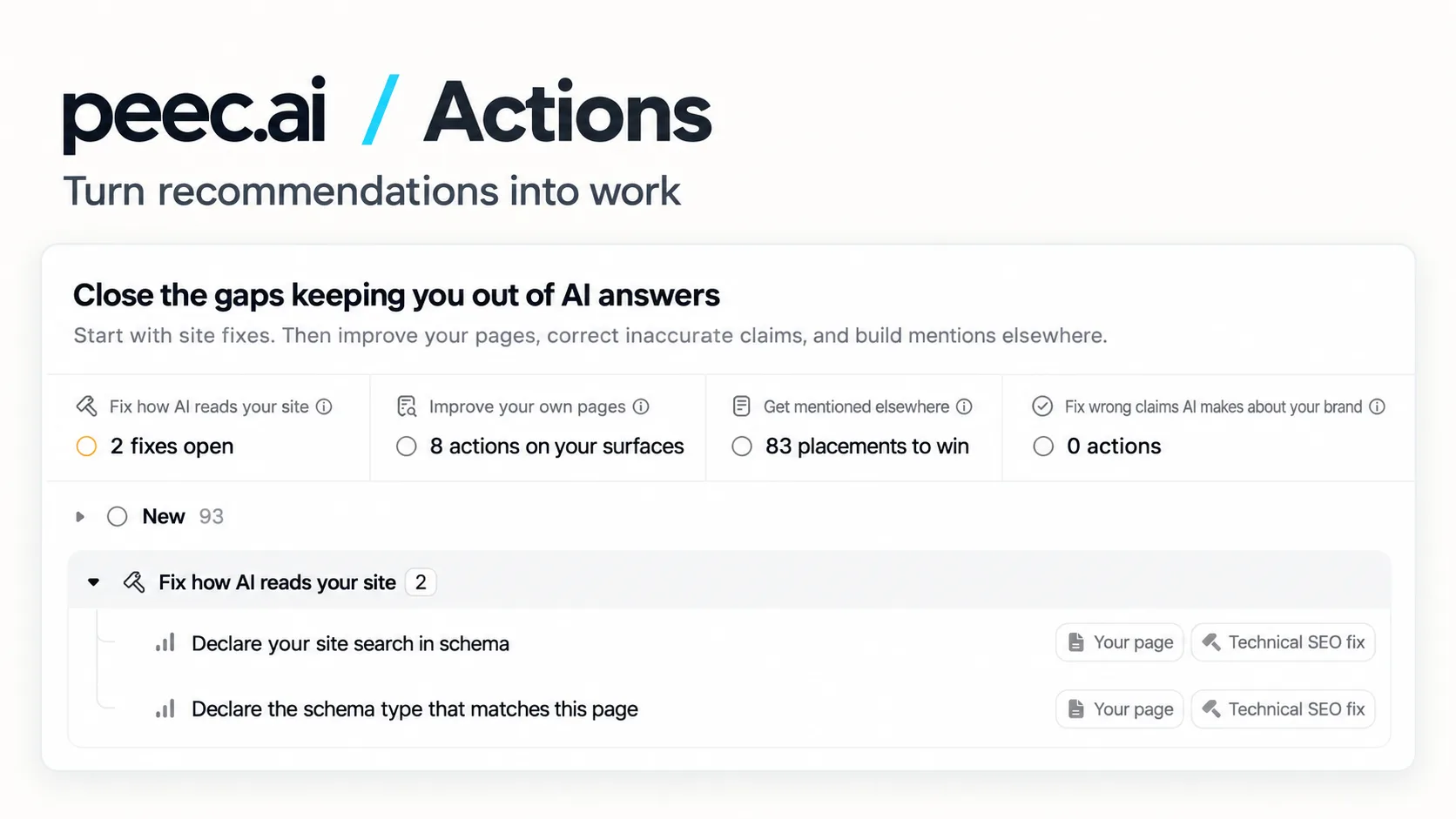
My Peec Actions overview, restyled for readability. The two open site fixes concern schema.
Peec gives me the recommendation and its foundation. Claude helps me relate it to GoodSender, account for the changes already made, and turn it into this week's work.
put your changes next to the visibility graph
The other feature I particularly like is the timeline.
Peec lets me look at the visibility graph with markers showing the work done and when it happened. That puts logged actions and visibility data in the same view. When visibility moves, there is a record of what we were changing around that time.
Peec calls this view Impact. In-progress and completed actions appear as markers on the visibility timeline, so you can review subsequent performance alongside the work. Its description of the feature also makes the limit clear: a marker does not prove that one action caused a particular movement.
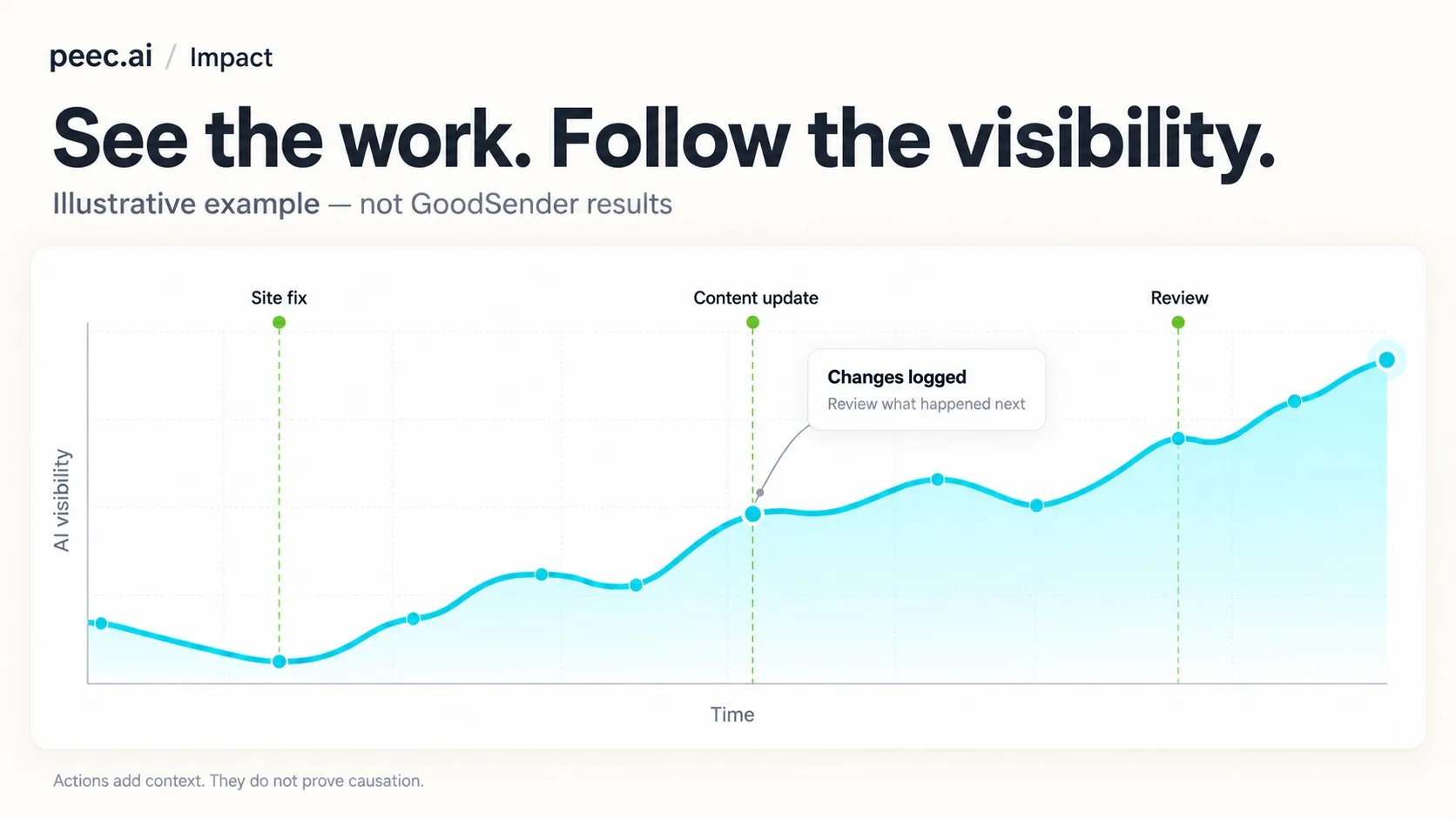
Illustration of the timeline concept. The rising curve is hypothetical; it does not show GoodSender's measured results.
For me, the value is being able to connect the work with what happened afterward and investigate it. A change has a date and a description. The graph has context.
That fits the weekly process well. The task list tells me what to do; the timeline helps me review what happened after we did it.
how I put it to work for GoodSender
I created a project in Claude Desktop called Goodsender analytics and connected Peec AI through its MCP server.
Peec tracks how the brand appears in the AI answers it monitors and supplies recommendations. Its MCP connection lets Claude query that data, inspect the sources appearing in those answers, and work with the recommended actions. Peec's MCP documentation describes that connection.
Then I set up a recurring report in Claude's scheduler for every Monday.
The job has three parts:
- Check the GoodSender website and what has changed.
- Compare those changes with the recommendations from Peec AI.
- Create tasks for me to work on during the coming week.
The second step is what makes the report useful to me. The site review and the recommendations need to meet: what have we already addressed, what still needs work, and what should happen next?
Claude helps turn that into work I can follow through on. During the week, we make the changes. The next report brings the updated site back into the analysis.
For anyone setting up something similar, Claude's scheduling documentation covers recurring tasks that use connected tools. My cadence is Monday; the useful part is having the review happen regularly.
Here is a compact version of the brief, reconstructed from my workflow rather than copied from the scheduled job:
Every Monday, review goodsender.com and the changes to the site.

Use the connected Peec AI project to review whether GoodSender
is mentioned in the AI answers being tracked, which sources
are cited, and what Peec recommends. Compare the website
changes with those recommendations.

Create a practical task list for this week. Explain the
evidence behind each task and what needs to change.

Keep Peec's findings separate from your own interpretation,
and flag anything you cannot verify.
Those final instructions make the example explicit about evidence. They are useful constraints to add when adapting it to your own product.
where I would start
If you are curious about the combination, start with one recommendation for your product. Ask Claude to explain the evidence behind it, connect it to the page or source involved, and propose a specific piece of work.
That gives you something useful to judge: whether the evidence is relevant, whether the recommendation makes sense for your product, and whether the proposed change is worth doing.
For me, that is the appeal of Peec AI with Claude. I can see why a task deserves attention, work through it, and return to the timeline as the data develops.
I've only been using Peec AI for a couple of weeks, so it's too early to talk about results. I'll share them here when they're available.